Opsis
Media Tech / Self-HostedSelf-hosted production control platform for church media teams - a Next.js BFF, an always-on Rust core, and live OBS control over WebSocket.
View Live Site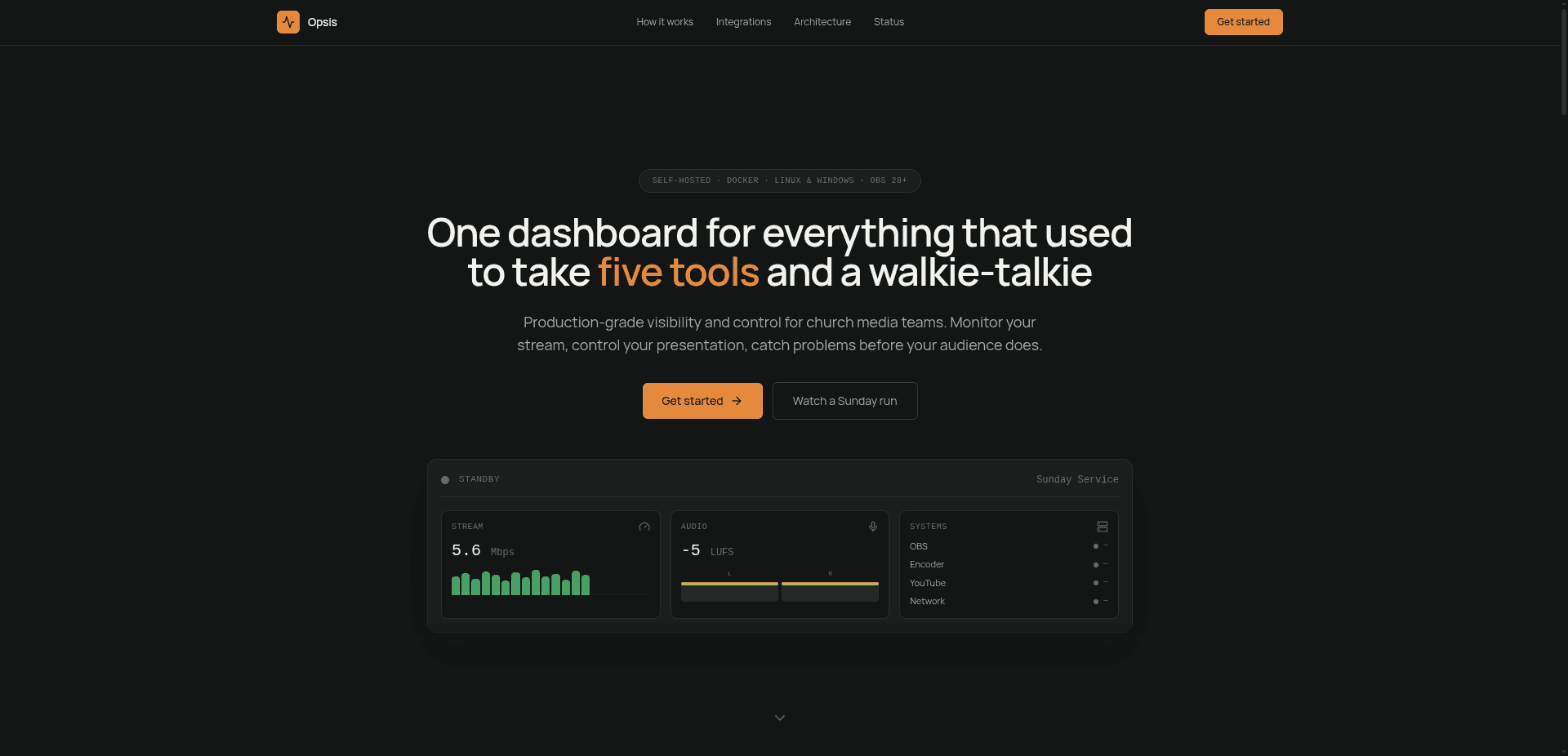
In progress
A self-hosted, single-organization platform that monitors and controls a church's live production stack. A multi-service system splitting a Next.js frontend/BFF, an always-on Rust control core, and live OBS integration over WebSocket.
Background
Church media teams run live production stacks with little visibility into what's actually happening and no safe, central way to control it. Opsis was built as a self-hosted platform that gives one organisation real visibility and safe control over that stack. The architecture deliberately splits responsibilities: a Next.js frontend doubles as a BFF and issues auth, while an always-on Rust core handles production control, talks to OBS, and runs a WebSocket hub. A shared JWT contract lets both services verify tokens independently, and the whole stack ships as a Docker Compose deployment that applies migrations and seeds a first operator on start.
What it has to get right
Designing a multi-service system where a Rust control core and a Next.js BFF each verify auth independently against a shared JWT contract, hold an always-on connection to OBS, and run as a single-command self-hosted deployment within a tight resource budget.
Solution
Built a Next.js BFF that issues auth and a Rust core that enforces it independently against a shared JWT verification spec, a WebSocket hub for live OBS control, and a Docker Compose deployment that applies migrations and seeds the first operator on first run - targeting under 200MB RAM and 5% idle CPU for the core.
Tech Stack
Related Service
Opsis went from an empty repo to a self-hosted, single-command deployment - a Next.js BFF, a Rust control core, and a shared auth contract between them. That full end-to-end platform delivery is the engagement model I work in.
See Multi-Tenant SaaS & Platform EngineeringProject Profile
Independent CDenn engagement, commissioned by two clients
Evidence
- Services
- Next.js BFF and an always-on Rust core
- Live control
- OBS over WebSocket
- Core footprint
- Under 200MB RAM and 5% idle CPUTarget
- Deploy
- docker compose up
- Target
- A budget the design was held to, not a figure measured in production.
- No label
- An implementation fact: this exists in the system.
Links
Interested in building something similar?
Get in touch